
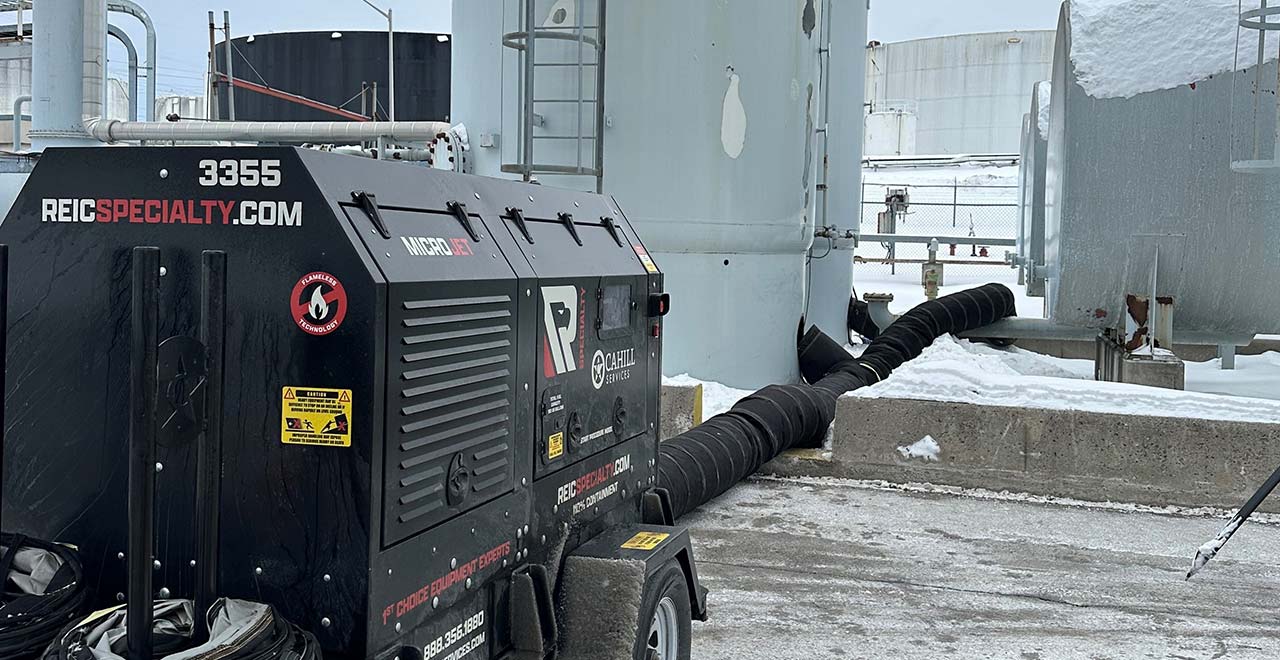
When it comes to painting, coating, and lining tank interiors or exteriors, environmental conditions play a crucial role. Coatings and linings require specific temperature and humidity ranges to cure correctly, adhere to substrates, and deliver long-term performance. Even slight deviations can result in:
- Extended curing times
- Adhesion failures or blistering
- Surface defects or premature coating breakdown
- Costly rework or warranty claims
Tank projects are particularly sensitive due to their large surface areas, enclosed or semi-enclosed spaces, and exposure to outdoor weather conditions. As fall and winter temperatures drop, maintaining those required environmental conditions becomes a major challenge.
That’s where temporary heating and moisture control come in. REIC Specialty delivers precise, reliable climate control systems that allow coating and pipeline contractors to work year-round—without compromising quality or safety.
Why Tank Projects Are Sensitive to Environmental Conditions
Unlike standard interior painting jobs, tank coating and lining work involves a combination of structural, environmental, and performance variables:
- Large, Exposed Surfaces
Tanks—especially in oil, gas, and industrial facilities—are often located outdoors. Their metal shells cool rapidly at night and during cold fronts, which affects surface temperature and increases the risk of condensation.
- Interior Microclimates
Tank interiors behave differently from exterior surfaces. Enclosed or partially enclosed spaces trap moisture and can develop their own microclimates, often with higher relative humidity than ambient outdoor conditions.
- Specialized Coatings
Many protective coatings and linings have narrow application windows, requiring minimum steel and air temperatures, as well as maximum relative humidity levels. Deviating from these specifications can lead to blistering, poor adhesion, or coating failure.
- Schedule Sensitivity
Tank projects often have tight schedules tied to pipeline operations, refinery turnarounds, or plant outages. Weather delays can ripple through entire operational plans, causing significant financial impacts.
The Role of Temporary Heating in Tank Projects
Temporary heating solutions from REIC Specialty provide controlled, stable environments that allow coating crews to maintain proper conditions regardless of the season. Key benefits include:
Maintaining Steel and Air Temperatures
Proper coating performance depends on both ambient air temperature and substrate (steel) temperature. Temporary heaters raise and stabilize temperatures within and around the tank, ensuring that coatings are applied under the manufacturer’s required conditions.
Preventing Condensation and Moisture Buildup
When warm, humid air meets a cold tank surface, condensation forms—often invisibly—leading to flash rust or adhesion problems. By controlling temperature and pairing heating with dehumidification when needed, REIC helps maintain dew point differentials that prevent condensation throughout the coating process.
Accelerating Cure Times
Maintaining optimal temperatures accelerates coating curing, enabling subsequent coats to be applied sooner and projects to stay on schedule, even during cold-weather seasons.
Extending the Coating Season
With reliable temporary climate control, painting and coating contractors can extend their working season well into the fall and winter, making better use of crews and reducing seasonal downtime.
REIC Specialty’s Heating Solutions for Tank Projects
REIC Specialty offers a comprehensive suite of temporary heating and drying solutions specifically designed to meet the unique demands of tank coating and lining projects. Our systems are designed to provide clean, dry, controlled air that supports coating application and curing in even the harshest environments.
Indirect-Fired Heaters
Best For: Enclosed or semi-enclosed tank spaces where clean air is critical.
- Provides heated air through ducting without introducing combustion byproducts.
- Ideal for maintaining air and steel temperatures inside tank shells.
- Prevents moisture and contamination from exhaust gases.
Flameless Heaters
Best For: Oil & gas, pipeline, or hazardous environments.
- Industry-leading safety—no open flame and no emissions at the point of use.
- Delivers clean, dry heat over long duct runs with exceptional efficiency (>97%).
- Excellent for heating tank exteriors or interiors without introducing moisture.
Desiccant Dehumidifiers
Best For: Low-temperature, high-humidity conditions.
- Removes moisture effectively, even in low temperatures.
- Maintains dew point differentials to keep tank surfaces dry and prevent condensation from forming.
- Ideal for interior linings and critical coating environments.
Refrigerant Dehumidifiers
Best For: Moderate drying in controlled or finished spaces.
- Portable and energy-efficient for use in adjacent areas or smaller tanks.
Integrated Heating & Drying Systems
Heating alone can increase humidity and cause condensation, while dehumidification alone may not maintain required temperatures. REIC Specialty combines heating and dehumidification to control both temperature and humidity simultaneously, ensuring ideal conditions for coating application and curing.
Scenario: Tank Lining Project in Late Fall
A pipeline contractor is preparing to apply a high-performance lining to a large crude storage tank in the Midwest in November. Nighttime temperatures frequently fall below freezing, and recent rainfall has pushed interior humidity levels above 80%. The project is on a tight turnaround, with the tank needing to return to service quickly—leaving no room for weather-related delays.
Challenges:
- Steel temperatures far below the coating manufacturer’s minimum requirements
- Interior relative humidity consistently above 80%
- A strict deadline for returning the tank to operation
REIC’s Solution:
REIC Specialty would deploy flameless heaters to safely raise both air and steel temperatures to the required application range. Desiccant dehumidifiers would be installed to remove excess moisture and establish a safe dew point differential. Air movers would be strategically positioned to ensure uniform airflow, eliminating pockets of cooler, more humid air inside the tank. To maintain these conditions despite fluctuating outdoor weather, REIC would provide 24/7 monitoring and rapid adjustments throughout the project.
Result:
With controlled heat, stable humidity, and continuous monitoring, the contractor would maintain ideal application conditions, stay on schedule, and achieve excellent coating performance with no adhesion or moisture-related defects—even in challenging late-fall conditions.
Best Practices for Using Temporary Heating on Tank Projects
To get the most out of temporary heating systems during tank coating and lining work, contractors should follow these proven strategies:
- Start Early
Deploy heating and drying systems before surface preparation to bring steel and air temperatures into spec and stabilize the environment. - Monitor Dew Point Continuously
Tracking temperature, relative humidity, and dew point ensures that steel surfaces stay dry during blasting, coating, and curing. - Size Equipment Correctly
Oversizing or undersizing heating and dehumidification systems can lead to uneven conditions. REIC engineers size systems precisely for tank volume, ambient conditions, and coating requirements. - Distribute Air Effectively
Use ducting and air movers to eliminate temperature and humidity stratification inside tanks, ensuring uniform curing and consistent coating performance. - Coordinate with Coating Specifications
Match heating and dehumidification strategies to the manufacturer’s recommended environmental conditions for each coating system. - Plan for Seasonal Shifts
Fall and winter bring rapidly changing conditions. Partner with a provider who can adjust equipment and monitoring as the project evolves.
The REIC Specialty Advantage
Painting, coating, and pipeline contractors across North America choose REIC Specialty because we provide turnkey, reliable, and compliant environmental control solutions tailored to the demands of complex tank and pipeline projects. Our team and technology keep work moving—no matter the season or conditions.
- Nationwide Coverage: 19 strategically located branches for fast, dependable deployment.
- 24/7 Response: Immediate support to meet tight schedules and shifting weather conditions.
- True Turnkey Service: Comprehensive site assessments, proper equipment sizing, professional installation, on-site monitoring, and timely removal.
- Proven Industry Expertise: Extensive experience supporting coating crews, tank lining projects, and pipeline operations of all scales.
- Advanced Technology: Access to industry-leading flameless heaters, indirect-fired heating systems, and high-performance desiccant drying solutions.
With REIC Specialty, contractors gain a trusted partner committed to safety, efficiency, and delivering the controlled environments that high-performance coatings—and tight deadlines—require.
Keep Your Tank Projects on Schedule This Season
Cold temperatures and humidity don’t have to slow down your tank projects. With REIC Specialty’s temporary heating and moisture control solutions, you can maintain ideal coating conditions, protect material integrity, and keep your timeline on track—regardless of seasonal challenges.
Don’t wait for the weather to stall your progress. Contact REIC Specialty today to build a proactive heating and dehumidification plan or to schedule rapid-response support for upcoming tank projects.